
Asset Allocation – First step in investing!

Don’t put all your eggs in one basket !

There’s an old saying that you shouldn’t “put all of your eggs in one basket”. It may not necessarily have been in terms of investing, however, it’s the perfect way to describe the importance of asset allocation in your investment strategy.

We put – asset allocation as a first step to investing!

This has also been the need of an hour considering the markets in India and across the globe strongly feel the hit due to COVID-19 pandemic crisis which may translate from health crisis to possibly worst ever financial crisis. During this time, if assets are allocated properly i.e. are in sync with one’s objective of investing then one can possibly sleep well!

What is an asset allocation?

Asset allocation may sound like a fancy financial jargon, but in simple terms, it just means spreading your investment money in different asset classes like equity, debts, cash, gold, etc.

As mentioned. asset allocation should be the starting point while building your investment portfolio.

How is asset allocation beneficial?

By spreading your investments in different classes of assets, it provides an opportunity to diversify the portfolio thereby minimizing the risk of losses linked with one particular class of asset.

Just to give a simple example – Equity markets in India are down YTD by ~21% (and this after meaningful recovery in last one month). Assuming, your entire portfolio is in equity, then you would have lost approx. 21% (subject to performance of your actual portfolio). During this time, if you need some liquidity then you would not have any other option but to sell some part of your equity portfolio resulting into booking of actual losses. Had your assets allocation being proper, some part of liquidity issue may have been solved from the emergency fund created or by redeeming debt fund without selling equity. Also, it may be worth to understand that each asset class has different risks attached, return expectation, volatility, liquidity, etc. and go through cycles. The graphic below captures certain nuances of each asset class:
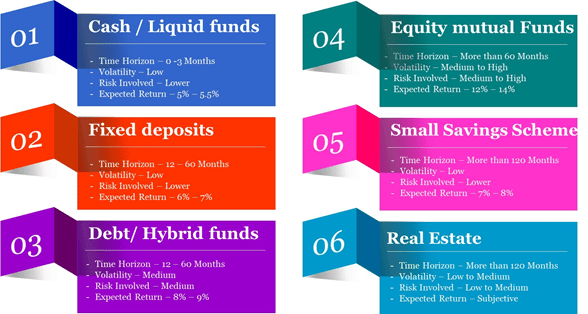
Considering above, a long-term goal can be achieved by having more aggressive assets such as equity mutual funds, while it is better to invest in safer assets to achieve short term goals. This balance is brought about by asset allocation. Here, it may be worthwhile to note in order to avoid confusion that diversification is different than asset allocation.

Is allocating assets a complex task?

As there are ample options available to invest, we now look at the aspects which are relevant to decide how much one should invest and allocate funds in each of the asset class.

General rule

As a rule, experts suggest that, one should allocate his assets in (100 – your age) format. Which means, the total that you get after reducing your current age from 100, is the percentage of the amount that you should invest in debt instruments and the rest is to be invested in equity.

For e.g., Mr. X is 25 years old, so accordingly, the percentage received is 100-25 = 75. Thus, 75% of his total investment portfolio should include equity-based instruments and 25% of his investment portfolio should include debt-based instruments.

The younger you are, the more risk you are capable of taking and higher should your % of equity allocations

This is simple technique which one can follow. Of course, there are questions as to where one should further allocate within the 75% bracket (i.e. direct equity stocks or equity mutual funds or ULIPs, etc.) and balance 25% bracket in debt (i.e. small savings scheme, debt funds, etc.)

Also, there are few unanswered questions like how much emergency fund one should have, how muck risk coverage one should have (term insurance, health insurance, etc.), how much investment one should have in gold and real estate, etc.

Thus, it may be imperative to note that there is no fixed rule on how an investor should allocate his assets, however, following factors will assist an investor in deciding the right asset of allocation.

Factors relevant to decide asset allocation

  • What is the objective of the investment goal? (e.g. investment for life, marriage goal, kids’ education, retirement, etc.)
  • What is my time horizon? (1 year, 5 years, 10 years, etc.)
  • What is my risk appetite? (I am fine if my portfolio is down by ~21%)
  • What is my level of income, sources of income and how much I can invest for the goal
  • What is my preference for liquidity? (Do I need immediately, after some time, etc.)

It is important to understand that the fundamental goal of investing is not to simply invest the money just for the sake of investing. It is to invest based on the requirements. If one is clear with the requirements, one can easily choose the ideal asset class for investment needs and thereby having overall right asset allocation. It is good to take help of financial advisor to plan the requirements as well as right asset allocation.

Once asset allocation is done – What next?

While investing is important, allocating your investments is even more important, assessing your investment periodically is extremely important for your wealth. There is no need to check the prices on every day or every week or every month basis of your portfolio, but at least it is important to review every 6 months or a year.

During such assessments, it is imperative to understand whether the investments are performing as per expectations, whether asset allocation is in place (it may change due to fluctuation in prices of assets wherein one has invested), whether there is need to find new avenues for investment or whether there is any need to discard an existing investment if things have not moved as per plan. There should be a structured review process the details of which we will cover some other day!

Who does not need asset allocation?

World’s richest investor, Warren Buffet has different view. According to him – “Put all your eggs in one basket and watch the basket very careful”.

In our view, this is true if someone understands the basket and can spend enough time and put enough efforts to watch that basket closely and carefully, otherwise, diversification through right asset allocation will not only help in preserving wealth but also generating it over a reasonable period of time.

Conclusion

Bad investment decisions, it is said, arise mostly from bad asset allocation. If, as investors, we get the asset allocation decision right, then we greatly reduce the chances of our investments turning bad. Please get in touch with us at manifeswealthadvisory@gmail.com in case of any further clarifications.


Term (Life) Insurance – Best tool to Secure Financial Future of your Family

1. Background

Financial Planning is an on-going process to help you make prudent decisions about spending, investing, and multiplying your income and assets to help you achieve your desired financial goals and dreams.

In layman terms, Financial Planning is nothing but identifying the sources of the funds and investing these funds in suitable avenues, which ultimately help in achievement of the financial goals and dreams.  Insurance planning is one of the key element of financial planning and we have discussed the same in detail below.

2. Why Insurance is a Necessity

As everyone knows that Life is uncertain and one can never predict what the future holds.  Whether it is possible to predict the timing of our death? The answer is No. Is it even imaginable what will happen to our family after our death?  These imaginations are scary and one should not dwell much in to this since it is beyond one’s control.

However, the right question could be what can we do so that our family have to suffer minimum loss from your death.  As someone has rightly said, every life has immense value and hence it may be an exaggeration to say that it is possible to cover the risk of loss of life since the grief for family members may be immense.  However, it is possible to make sure that one’s family is financially secured in his absence also by making an appropriate Insurance Planning.

Insurance planning is to protect yourself, your family and loved ones, your home, your assets, or your business against unexpected events.  It is a critical component of a comprehensive financial plan that includes evaluating risks and determining the proper insurance coverage to mitigate those risks. The principal goal of insurance planning is to identify and analyze risk factors of one’s life/ business and seek proper coverage to attain a peace of mind if disaster strikes. The chances of recovering partly or fully are assured by having commensurate insurance. Therefore, insurance is an economic device transferring risk from an individual to a company and reducing the uncertainty.

As it is said “LIFE” is full of IFs and most of us have big plans in their mind for the future but achieving those dreams depends on many IFs.  As you would agree that most of us have few common events lined up for future which require huge financial commitment eg buying a dream home, repayment of existing debt/ loan, higher education of kids, marriage of son/ daughter, medical need of parents, continuation of existing lifestyle of family, etc.  As these events are very common for any human being, it is highly advisable to prepare and put in place a financial plan to secure their loved ones against many IFs of Life. 

One first element of financial planning is to buy a reasonable amount of Life Insurance as Life is the most uncertain thing which is surely going to occur.  While you may have a great financial plan to build wealth over next 15-20 years, but same would be of no help if you die natural or by accident or by a victim of COVID-19 during the course of achieving it.  Hence, Insurance is a must to safeguard the financial security to your family. The following depiction truly sums up the need of buying a life insurance:

Primarily, following are the two types of life insurance plans available in India:

  1. Term Insurance (Pure Risk Cover Plan)
  2. Traditional Life Insurance (Investment-linked plans)
    • Unit Linked Insurance Plan (ULIP)
    • Endowment Plans
    • Moneyback Plans

While most of us are aware of Traditional Life Insurance, not many are aware of the concept of Term insurance in India or how the term insurance plan operates. Given the same, we have discussed in detail the key features and benefits of subscribing to term insurance as it is the need of an hour considering the situation we are sailing through.

3. Term Insurance – Key Features

Term Insurance Plans are the simplest and most affordable form of Life Insurance as it promises to pay an assured amount only if the insured person dies during the term of the policy. In the event of death of an insured person, the sum assured would be paid to the nominee which ultimately assure your loved ones to enjoy the life on same status as they are enjoying as of now. While there are options available to opt for return of premium option if the policy holder survives the entire policy term, however, under pure term plan, there is, usually, no maturity benefit payable under this plan. Therefore, terms plans called pure protection plans. 

Against this, Traditional life insurance plans, like endowment or money back plan, have a saving element in them. They promise to pay either a death benefit in case of death during the term or a maturity benefit if you survive the term of the policy.  However, the maturity benefit, per se, would be very negligible and unattractable if one considers the inflation and other investment avenues available. 

As against this, higher level of sum assured at very affordable premiums is the only important factor which differentiates a term insurance plan from other plans of life insurance. While traditional plans might give you guaranteed returns, term plans offer you the option of getting a sufficiently large sum assured at a very low cost. Eg – A person aged 25 can get a term insurance of INR 1 crore by paying a premium of only INR 10,000-12,000 per annum.  Buying such a low-cost plan allow you to give your family a complete sense of financial security in any unfortunate event of your death.

Given such features, wealth managers advise their clients to buy term insurance first as it provides a pure life cover and further, they are comparatively inexpensive and most affordable when compared to any other form of life insurance plan.

4. Term Insurance – Key Benefits

Considering the key feature of Term Insurance, you would now agree that actually there is no choice but to opt for pure risk coverage plan i.e. term insurance.  We have summarized below the key benefits of pure term insurance:

  • Massive coverage with low premium

This is one of the biggest benefits of term insurance plan.  A person having an income of INR 20 lakhs can even take a insurance of INR 5-7 crores at a reasonably low premium.  Further, earlier you take the policy, lower will be the premium amount and same would be constant for the entire premium paying term.

  • Provides life-long coverage

Term insurance provides life-long coverage i.e. coverage for 40 years from the date of availing policy or even up to 100 years of age.  Accordingly, taking longer coverage would provide you certainty that it would most likely be matured and would not lapse.

  • Return of premium

Now a days, companies have also launched term plan which provides return of premium plan wherein if the policyholder survives the policy, he or she will get a maturity benefit in terms of all the premiums paid.  

  • Waiver of premium

Under this feature, the premium is waived in case the policyholder gets critically ill, seriously injured or disabled and the policy is continued. This may be useful in a situation where income is impacted due to an unfortunate event and ability to pay premiums is compromised.

  • Terminal illness

If one opts for rider of terminal illness and in case, insured person got hospitalized with specified terminal illnesses, 50% of sum assured would be paid upfront to the family member.  This would help the family member to use money on medical treatment to save him which may even save the person. 

  • Optional Riders

Other riders in form of accident insurance benefits, etc. are even available wherein if person die due to accident, twice the sum assured would be paid to the family.

5. Income-Tax Benefit of Term Insurance

Section 80C of the Income-tax allows a deduction up to INR 150,000 for the premium paid towards term insurance and thereby depending on the tax slab rate the person paying premium is falling into, he can save the outflow of tax up to an amount of INR 55,000 every year.  Further, the maturity amount received on death is also tax-free under Section 10 (10D) of the Income-tax Act.

Further, Companies or Firm can also take the term insurance of their keyman to safe guard themselves against his death.  The `keyman’ would be any person employed by a company having a special skill set or substantial responsibilities and who contributes significantly to the profits of that organization.  Further, company buying keyman insurance can claim a deduction for the premium paid for the policy as a business expense under Section 37(1) of the Income Tax Act. However, the amount received on death is not exempt under Section 10 (10D) of the Income Tax Act. There are ample of planning avenues available to take the term insurance to gain the maximum tax advantage within the four corners of Law.  However, it depends of fact of each case and in case, you wish to evaluate the available options, you can reach out to us on manifestwealthadvisory@gmail.com

6. Still, what is holding you back

Every one of us knows deep down that they need life insurance, but most of us don’t have an adequate policy in place. While some have traditional life insurance policies but the sum assured seems not enough considering the future lined up events such as payment of loan, education, marriage, etc.  

Most of the people, may be including you, hold back to buy life insurance as they just don’t want to think about their mortality or consider insurance as a dead investment. While we would buy the insurance for non-living product such as car as we would like to secure the financial risk in case of loss of car or accidental damage of car, but we would not buy the insurance for the most precious thing ie LIFE, one of the greatest ironies of the world.

Consider for a moment situation like you are affected by COVID-19 and due to unavailability of proper medical treatment or other health issues, you lose your life and leave your family alone to survive.  Resultantly, your family will become the victim due to your sudden death and that too without having any sizeable Life insurance plan in place.  This would leave your loved ones financially vulnerable leading them to forcibly living a miserable life. Imagining event like this is even scary then just think about how scary the reality would be. Trust, now you would have overcome all the excuses for not buying a term insurance and would take a step forward to secure the financial future of your family.

7. Concluding remarks

Given all the above, you would certainly agree that Term Insurance, being very low priced and straightforward, is the best and simplest kind of life insurance that continues to cover and protect your loved ones even when you are not there.  

Considering the current situation the entire world is going through and accepting the fact that this highly uncertain time would going to last for a fairly long time, it is advisable to have a look at your financial goals, dreams and compare it with the life insurance you possess currently and if you are of the opinion that it would certainly not take care of the future of your family, don’t even delay a single day to buy the commensurate size of Term insurance.  Having a sizeable amount of life insurance would guarantee you that your family would appreciate your decision in their life after your death.

While there are many factors which you must decide before buying a term insurance eg how much should be the term of the policy, how much sum assured you require, which rider to add-on, which policy to take, etc. and hence, it is very important that you buy any term insurance after having detailed discussion with the financial advisor as it can be the most important financial source of income for your family after your death. 

You can definitely reach out to us on manifestwealthadvisory@gmail.com

Power of Action

We are responsible for what we are, and whatever we wish ourselves to be, we have the power to make ourselves.

If what we are now has been the result of our own past actions, it certainly follows that whatever we wish to be in the future can be produced by our present actions; so we have to know how to act.”

– Swami Vivekanada

Action – Key element for Success

Action is the most important factor for achieving any Success in any of the areas. One may have all the knowledge in the world, but if he do not take any action and apply that knowledge, there is no use of it.

We may have a dream, might even have faith in the dream, but if we do not take any action towards it, it will be mere wish only and nothing will come out of it. Just like a caring mother who takes care of a newborn baby until it becomes an adult, we will likewise have to nurture and fend for our idea or goals, feed it every day, provide loving nourishment and support everyday by taking necessary actions required to accomplish it. During this, there will be moments of joy, some hiccups, sickness and healing along the way but this is part of the process.

When our idea, dream or vision grows up and becomes a toddler then a teenager and then an adult we will look back with pride and say to ourself “Wow! I did it” and that would be the moment of real success which have been possible because of our Action and at that moment we will realize the importance of our decision and action.

Why Action is so powerful? What happens when we take Action?

Taking action is always positive. As soon as we take action, we will feel energetic and as a result, our mind will become positive. Once we take action, our subconscious mind will also become active and will help us to find out the ways for overcoming the obstacles.

Most people do not take action as they have various kinds of fears. What is fear? Fear is F.E.A.R. i.e. ‘False Enemy Appearing Real.’ So, fear is an enemy that does not exist but it appears so real in our mind that we create a mental monster and are scared to take action. Paradoxically the only antidote to fear is Action.

We have fears in our mind because of either ignorance or because of our past failures that are rooted deep in our sub-conscious mind. When we take action we gain experience and when actions produce results and we see ourselves performing the experience of failure in our sub-conscious mind is overwritten with an experience of success. In fact not taking action only strengthens our ignorance and our fear.

Inaction is also an Action

Just as indecision is a decision, inaction is also an action. Most of us have ideas, thoughts, goals, plans in our mind but either due to our busy life, fear of failure, fear of loss of comfort zone, we tend to postpone taking any decision or action to pursue those ideas or goals which ultimately lead us to mediocre life.

Study shows that majority of people around the world at their death beds, do not feel proud of their actions or achievements but regret most of those actions and risks they did not take. Survey shows that people in their 50’s agree that when they look back on their past, the most common regrets are not the risks they took, but the ones they didn’t and those generate the greatest despair.

But we can do something about what we truly want in life now. We don’t have to have many regrets when we can seize the moment today by taking the decision or action. There are more opportunities to completely reinvent our role in the system than ever before

Power of Intention

The power of intention will ignite our subconscious mind which will work round the clock to achieve the desired goals and dreams. It brings energy to our actions and assures we can accomplish our purpose. Our conscious intention works for us as a good business plan: if our words and actions don’t serve the goals set out in the plan, we know we don’t need to waste energy on them.

Actions performed with the power of intention benefit from our full energy when we haven’t wasted it on thoughtless or counter-productive words and activity. Words and actions that flow from our conscious intention have the power to engage others in our vision.

Take Action NOW

We have been trained by the society to stop thinking and do as we have been told ie Living the Life by Default. But as we have witnessed dreamers and thinkers can only change the world. They are the new untouchables and they don’t follow any logic. As we have seen recent success stories of many entrepreneurs and startups including the most famous Amazon, Apple, Alibaba who have gone against the tide while starting their venture and made it the most profitable venture by taking a decision/ action and following their subconscious mind.

It is crystal clear that a more richer and exciting life is within our grasp if we can visualize and focus on thinking and most importantly acting on our thoughts. Think about all the dreams and plans that have not been realized because we are just afraid to come out of our comfort zone or share themselves with the world. And then make concrete plan to convert those dreams and plans into action/ reality. If we pursue our dreams long enough, compounding will take effect and one day, we will also join the club of dreamers and thinkers who took action.

Trust you like the article, kindly provide your comments or feedback on manifestwealthadvisory@gmail.com

Complex world of Tax Saver Instruments in Layman terms

“Investing is for wealth preservation, not wealth creation, so first you have to make wealth.”
— James Altucher
  1. Background

As it is rightly said, three things in life are certain, Death, Taxes and Bills.  However, there are multiple ways to save taxes nowadays which will help not only to save outflow of taxes currently but will also help build a corpus for future.  There are various tax saver instruments available that provide tax benefit, thereby, significantly increasing the effective investment portfolio return.

As we are coming close to the end of financial year, every taxpayer would be busy in finding out the best way to save taxes.  Considering the same, in this article, we have analyzed the best tax saving options that can help a taxpayer reduce his tax outgo as well as earn commensurate return over long term. 

While the analysis of each instrument and its tax benefits study has been given in general, it may varies from taxpayer to taxpayer considering their other taxable income, investment horizon, risk appetite, etc.  Accordingly, it would be advisable to select any of the tax saver instrument after consulting financial advisor or CA.

  1. Comparative summary

Comparative summary of the key Tax Saver Instrument is as under:

  • Public Provident Fund (PPF)
ReturnFixed Rate of Interest (interest rate set by the government)
Current Rate of Interest is 7.90%
Lock in15 years. Can be extended for block of other 5 years
AdvantageHigher security
Disadvantage– Very long lock-in period. Return not lucrative enough to lock the fund for such a long period
– Since interest rates are reviewed periodically, will carry risk of lower interest rates going forward
  • National Savings Certificate
ReturnFixed Rate of Interest (interest set by the government)
Current Rate of Interest is 7.90%
Lock in5 years
AdvantageHigher security. Lower lock-in period compared to PPF
Disadvantage– There is no premature withdrawal possible and hence, funds would be blocked and may not be used even in case of emergency
– Since interest rates are reviewed periodically, will carry risk of lower interest rates going forward
  • Fixed Deposit
ReturnFixed Rate of Interest (interest set by the government)
Current Rate of Interest is 7.9%
Lock in5 years
AdvantageHigher security. Facility of premature withdrawal with penalty
Disadvantage– Returns are lower than PPF and NSC.
– Carries risk of Bank being declared default.  However, FD worth of maximum INR 1 lakh is insured
  • Equity Linked Tax Savings Scheme
ReturnVariable and linked to market
Lock in3 years
Advantage– Higher return compared to all other instruments as investment is made in listed equity shares
– Can yield higher return subject to investment is made in good quality tax saver scheme
– Can help in creating wealth over longer period of time as returns are far higher than inflation of our country
Disadvantage– Since returns are linked to market, may generate lower return in near term
– In times of market correction due to some external events such as war or financial crisis or recession
  • National Pension Scheme (NPS) – TIER 1 Account ie NPS Scheme
ReturnVariable and linked to market
Lock inLock-in till attainment of 60 years of age. 
Further, at maturity also, only 60% of the corpus is redeemable, balance 40% of has to be invested in annuity plan and will be given in monthly payout form
AdvantageHigher security.  If selection of instrument is done in a right way, can help to create the wealth for retirement
Disadvantage– Very long lock-in period
– Post lock-in also 40% of the funds would be released in the form of monthly payout

  1. Conclusion

As detailed out above, there are multiple ways to save tax, it is wise to select an option that offers you dual benefits of tax saving as well as wealth creation. Further, the investment plan differs from person to person considering his investment horizon, investment goal, risk profile, etc.  Given the same, it is highly advisable to study each of the aforesaid factors in detail before making any investment in any of the tax saver instruments listed above. 

Further, it would be advisable to plan taxes in advance, seek the best way to optimize your taxes and utilize the tax exemption limit completely as it would be the most critical factor in creating wealth over longer period of time.

As Warren Buffet said, “Don’t put all eggs in one basket”, it would be squarely applicable for investment in tax saving instruments as well.  Accordingly, it is advisable to plan taxes in advance, seek the best way to optimize taxes, invest in different tax saver instruments considering investment goals and risk profile to build the wealth over longer period of time.

We would be publishing number of articles on Financial Instruments along with implications of Direct Taxes on it and ways to create Long Term Wealth in near future.  In the meantime, do let us know your thoughts or reach out to us in case you have any query with respect to our analysis detailed out above.  We can be reached out on manifestwealthadvisory@gmail.com

Design a site like this with WordPress.com
Get started